
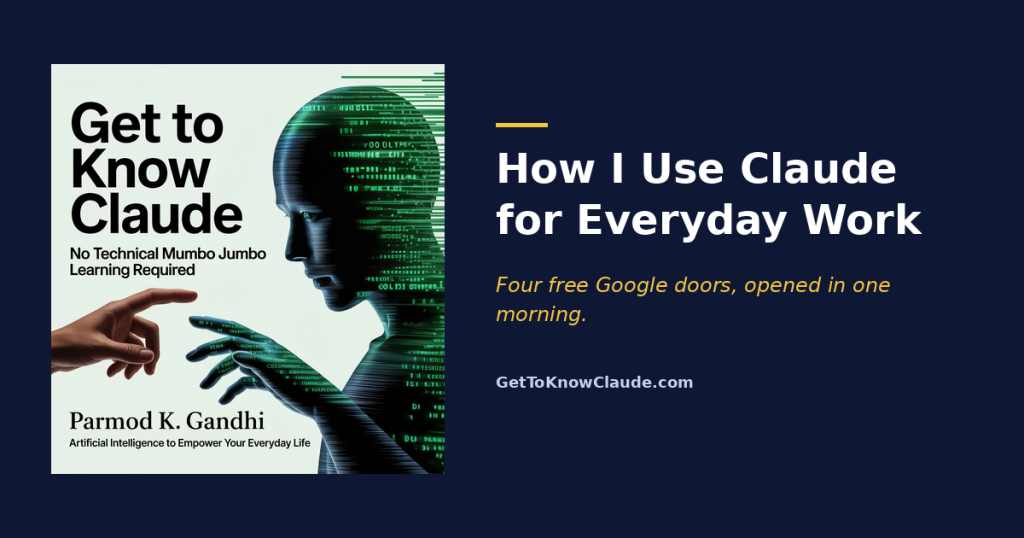
I have become a regular user of Claude. I ask for advice all the time — on writing, on publishing, on technical problems, on investment decisions. It has become part of how I work.
This morning I was thinking about expanded advertising for Get to Know Claude. The book has been doing well on Amazon Kindle since April, but I had no presence on Google or Instagram. So, I asked Claude a simple question: how do I advertise for free on Google?
Here is what transpired.
Door 1: Google Play Books Partner Center
I did not know Google Play sold ebooks. I did not know that a single free signup gets your book indexed in Google Books search and listed for sale on Google Play. Same workflow, two outcomes. When someone Googles a phrase that is inside my book — “how do I get Claude to build a website,” for example — my book can now show up in regular Google search results, not just on a bookstore page.
I uploaded the Spanish edition first. The English edition is locked into Amazon’s exclusivity program until July 19. The Spanish edition is not, so it launches on Google Play immediately.
Door 2: Google Business Profile
This one I had dismissed as something for restaurants and dentists. Wrong.
Superior Home Automation Corp. — my publishing company since 1987 — now has a free Business Profile. It appears when anyone searches the company name, shows the publishing imprint, links to my book site, and establishes the company as a real entity that Google’s algorithms trust. That trust matters for Door 4, which I will get to.
One thing Claude caught that I had missed: my home address was sitting in plain view on the profile, complete with a map pin on my house. The setup form had defaulted to displaying it. I had scrolled past without noticing. Claude flagged it the moment I pasted the screenshot and walked me through hiding the address behind a service-area setting. Without that catch, I would have left my home address on Google for the world to see.
Door 3: Google Search Console
This is the back office of Google for any website owner. It tells you which searches are bringing visitors to your site, which pages Google has indexed, and whether there are technical problems. Free. I verified GetToKnowClaude.com in about ninety seconds — Cloudflare handled the verification automatically.
The data takes a few days to populate. But once it does, I will know exactly what readers type into Google before landing on my site. That is marketing intelligence I could not have bought.
Door 4: Schema Markup
This is the door that would have been impossible without Claude.
Schema markup is invisible code in the HTML head of a website that tells Google: this is the author, this is the book, this is the publisher, here is the ISBN, here is the Carnegie Mellon affiliation. It is how Google builds Knowledge Panels — those information boxes that appear in the right column when you search for a well-known author’s name.
I had read about schema markup before. The official documentation is dense, the JSON-LD format is finicky, and I had quietly put it in the “someday when I have a week to study it” pile.
Claude wrote the entire schema script in three minutes. Organization schema for the company. Person schema for me, including the Carnegie Mellon adjunct appointment. Book schema for Get to Know Claude, including both the eBook and hardcover ISBNs. Website schema linking everything together. All four entities cross-referenced with proper internal links, so Google understands they are related.
My job was to open header.php in WordPress, paste the script just before the closing head tag, and click Update File. Total time: about ninety seconds. Time saved compared to writing it myself: at least a week of reading and trial-and-error.
What I Took Away
Here is what struck me about this morning.
I did not ask Claude to plan a marketing strategy. I asked one specific question — can I use Google for free advertising? — and Claude expanded it into a working plan, then walked me through each step in order.
When I got stuck, I pasted a screenshot. Claude read the small print I had missed and told me what to click. When I needed code, I did not know how to write, Claude wrote it. When I made a mistake — I pasted the schema script before the wrong closing tag, two tags that look almost identical — Claude caught the error from my next screenshot.
The lesson is simple. This is how I work now. I ask the questions I would have once asked a colleague, an accountant, or a web developer. Claude does not replace any of them. But for the day-to-day decisions that fill most of my work hours, having a thinking partner available at any hour, on any topic, has changed how much I can get done in a morning.
Not bad for a morning’s work that found a new channel for sales and advertising without spending a dime.
Parmod K. Gandhi is the author of Get to Know Claude: Artificial Intelligence to Empower Your Everyday Life, available on Amazon Kindle and shortly on Google Play Books. GetToKnowClaude.com
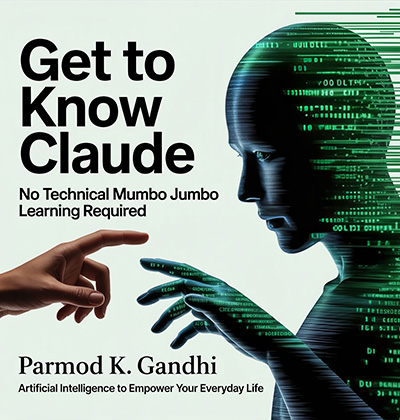
Get to Know Claude
Artificial Intelligence to Empower Your Everyday Life
“Not an assistant. Claude is a thinking partner. The difference is everything.”
Buy on Amazon →