

Jensen Huang at Carnegie Mellon University’s 2026 Commencement. Image: Carnegie Mellon University.
Three days before Get to Know Claude went on sale, someone left two words on my Facebook post: evil, GARBAGE.
I think about that comment more than I think about the likes. Because the person who wrote it is the person this whole conversation is actually about.
He read enough to react. He cared enough to say something. And underneath the anger, what I heard was fear — the kind of fear that doesn’t come from nowhere. He has probably lost something already, or watched a friend lose something, and a book about AI showed up in his feed celebrating the very thing he blames.
I want to write to him directly. And to anyone else who feels the same way.
Yes, some jobs will go
I am not going to pretend otherwise. Goldman Sachs estimates that around six to seven percent of jobs will be displaced over the next several years as AI is adopted. Office and administrative work, legal research, certain kinds of writing and analysis — these are the roles where the change is happening fastest. Anyone who tells you nobody will be affected is selling you something.
That is the honest part. The fear is not paranoid. The fear is based on something real.
But it is only half of the story. And the other half is the part nobody is telling you, because outrage gets more clicks than perspective.
Jensen Huang at Carnegie Mellon
Jensen Huang — the CEO of NVIDIA, the company whose chips power nearly every AI system on the planet — stood in front of the graduating class at Carnegie Mellon University. That is the university, where I hold an honorary appointment as Adjunct System Scientist. So, I was paying close attention.
He did not speak to the computer scientists and the PhDs. He spoke to a much broader room. Here is what he said:
“AI gives America the opportunity to build again. Electricians, plumbers, iron workers, technicians, builders — this is your time. AI is not just creating a new computing industry, it is creating a new industrial era.”
He has been calling it something even bigger than that. The Fourth Industrial Revolution. The first three were steam, electricity, and the computer. Each one frightened people. Each one displaced workers. And each one, when the dust settled, created more jobs and more prosperity than it destroyed — by far. Huang is arguing that AI is the next one in that sequence, and that we are standing at the very beginning of it.
If he is right, the question is not whether to be afraid. The question is whether to be on the right side of it. Think of AI as a powerful tool at your disposal.
Why does Huang believe this? Because AI is not a piece of software floating in the cloud. It runs on physical machines, in physical buildings, drawing physical electricity. The buildout to power it requires hundreds of thousands of new electricians, welders, technicians, and construction workers. Demand for skilled trades is already up twenty-seven percent over the last three years. McKinsey projects the United States will need an additional one hundred and thirty thousand electricians and a quarter of a million construction laborers by 2030 just to keep up.
The World Economic Forum projects one hundred and seventy million new roles created and ninety-two million displaced by 2030. A net gain of seventy-eight million jobs. Not fewer. More.
Who actually loses?
The people who lose in this transition are not the ones whose jobs get automated. Jobs have been getting automated for two hundred years. The people who lose are the ones who refuse to engage with the new tool, while everyone around them learns to use it.
Huang said something else at that talk that I keep coming back to:
“My greatest concern is that we scare people — to the point where AI is so unpopular that people are so afraid of it, that they don’t actually engage it.”
That is the trap. The person who calls AI evil and refuses to touch it is not protecting their job. They are guaranteeing that the person sitting next to them — the one who learned to use Claude — will be the one who keeps their job.
This is why I wrote the book
I did not write Get to Know Claude for engineers. I wrote it for the small business owner whose time is being eaten alive. For the writer who has been putting off the book inside her. For the retiree who wants to keep learning. For the electrician who wants to know if this thing can actually help him with his quoting and invoicing. For the person who has tried ChatGPT once, walked away unimpressed, and assumed AI was not for them.
The book is not a celebration of AI. It is a hand offered. A clear, plain-language guide to using one specific tool — Claude, made by Anthropic — to do useful, ordinary things in everyday life. Write a letter faster. Understand a medical report. Build a website in an afternoon for under twenty dollars. Learn a language at your own pace with the most patient teacher you will ever have.
Nothing in those examples replaces a human job. Every one of them gives a human being a tool that makes their own work better.
To the person who left the comment
I understand. The fear is real and the displacement is real and you are not wrong to be worried. But the book is not garbage, and I would gently argue it is not evil either. It is one author trying to help ordinary people find their footing in a change that is happening whether any of us approve of it or not.
If Jensen Huang is right, and this really is the Fourth Industrial Revolution, the question is not whether it is coming. It is already here. The question is whether you arrive at it with the tools to thrive, or whether you arrive at it empty-handed.
You do not have to like AI to use it well. And using it well is increasingly part of being employable in 2026.
If you want to know what this thing actually is, before you decide what to think of it, Chapter 1 is free at GetToKnowClaude.com. No email required. No sign-up. Just read it, try it and see.
The door is open. Walk through it or do not. But at least know it is there.
— Parmod
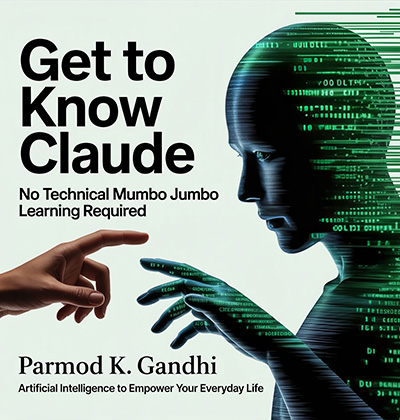
Get to Know Claude
Artificial Intelligence to Empower Your Everyday Life
“Not an assistant. Claude is a thinking partner. The difference is everything.”
Buy on Amazon →